Complete guide
Cycling in Siargao.
The complete guide.
Everything to plan your cycling trip on Siargao Island, Philippines. Routes, climate, bikes, logistics — written by people who actually ride here.
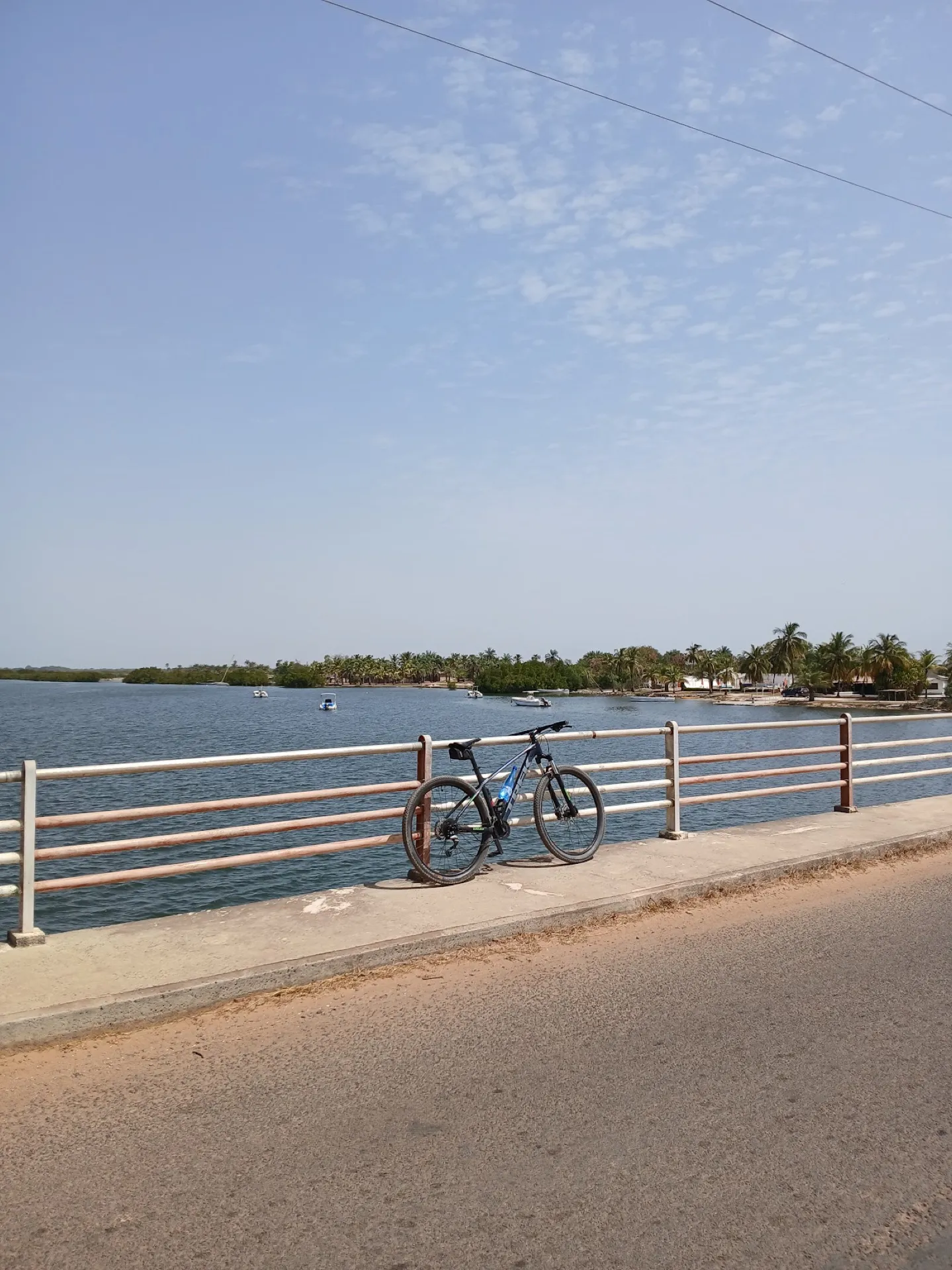
Siargao is the surf capital of the Philippines — but in 2026 it's quietly becoming one of the best cycling destinations in Southeast Asia. Flat-to-rolling terrain, a 134-km circumferential road with near-zero traffic, dense coconut groves and an inland network of village tracks that come alive after rain. Whether you ride gravel, road, MTB or e-bike, the island delivers.
Why Siargao is great for cycling
Three things make Siargao stand out as a cycling destination:
- The terrain works. Max elevation 60 m, gentle rollers, no climbs. The 127 km island loop has only 750 m of total elevation gain — your legs aren't the limit, the heat is.
- The roads are friendly. The Siargao Circumferential Road is wide, well-paved, and outside the General Luna–Dapa corridor it carries very little traffic. Drivers are generally patient, dogs are mostly asleep.
- The scenery delivers. Cocoteraies stretching to the horizon, postcard beaches every 10 km, mangroves at Del Carmen, the legendary Coconut Road through dense palm canopy. It's not Mallorca, but it's better-looking.
When to go (climate, winds, seasons)
Siargao has a tropical maritime climate with no real dry season, but the difference between "dry-ish" and "wet" is significant for cycling.
- January–April: the cycling sweet spot. Driest, calmest winds, mornings around 26°C, afternoons 30°C. Best months: March and April.
- May–September: warm and humid but ridable. Frequent short showers that don't ruin a day. The shoulder season has fewer tourists and lower accommodation prices.
- October–November: typhoon window. Possible to ride but check forecasts daily. Skip if you can.
- December–February: amihan (north-east monsoon) brings the wettest period and stronger winds from the east. The Coconut Road becomes mud in places. Possible, but plan inland routes carefully.
Whatever the season, start at sunrise (5:30–6:00). By 10 a.m. the heat is the real climb, not the elevation.
How to get to Siargao
Siargao has its own airport (Sayak / IAO) with daily flights from Manila and Cebu. Flight time: 1h30 from Manila, 1h from Cebu. Airlines: Philippine Airlines, Cebu Pacific, AirAsia.
Alternative: ferry from Surigao City (3 h, scenic) for those who want the slow approach. Surigao City is connected by ferry from Mindanao or by RoRo from other parts of the Visayas.
From Sayak airport: shared van to General Luna, ~45 minutes, ₱300 per person. Most accommodations arrange pickup.
Where to stay as a cyclist
For cyclists, location matters less than you'd think — distances are short. But three zones make the most sense:
- General Luna (Tourism Road, Cloud 9 area): the main hub. Cafés, restaurants, supplies, repair contacts. Best for first-time visitors and short stays.
- Pacifico: the quieter cousin, 25 km north. Postcard beaches, fewer crowds, a great point-to-point destination from General Luna.
- Burgos / Pilar: for the cyclist who wants to escape entirely. Few amenities, fewer cyclists, much quieter roads.
Bike-friendly accommodations (request a secure bike storage at booking): Bravo Beach Resort, Lamana Eco Resort, Kalipay Resort, Nay Palad (luxury), Salamat Villa (coliving for nomads).
The three routes you should know
We've mapped, tested and published GPX for three loops covering the full difficulty spectrum:
| Route | Distance | Elevation | Level | Bike |
|---|---|---|---|---|
| General Luna Easy Loop | 26 km | 110 m | 🟢 Easy | Hybrid / e-bike |
| Coconut Road Short Loop | 48 km | 280 m | 🟡 Moderate | Gravel / e-bike |
| Coconut Road Loop | 127 km | 750 m | 🔴 Hard | Gravel / road |
All three start in General Luna and end in General Luna. All three have GPX files freely downloadable. All three pass through the iconic Coconut Road, the inland palm corridor that's the defining cycling experience of the island.
Which bike to pick
Your bike choice depends on the route and the conditions:
- Gravel — the do-it-all option. 90% of cyclists on Siargao should pick this. Handles the Coconut Road, the asphalt, and the inland village tracks.
- Road — pure speed on the Circumferential Road. You'll sacrifice on the Coconut Road's broken sections.
- Mountain bike — for inland exploration, post-rain mud, off-asphalt adventures. Overkill for the main routes.
- E-bike — for non-cyclists, beach-hoppers, or anyone who wants to cover distance without sweating in the heat. No license needed.
Logistics & on-the-ground tips
The practical stuff that matters once you're rolling:
- Cash: ATMs in General Luna and Dapa only. Carry pesos for sari-sari stores (₱20–30 for a bottle of water).
- Water: 2 L minimum for the long routes. Refill at every sari-sari you see — they're everywhere.
- Spares: spare tube, plug kit, mini-pump, basic multi-tool. Bike shops outside General Luna and Dapa are rare to non-existent.
- Phone signal: Globe and Smart cover most of the island, but inland and northern sections have dead zones. Download offline maps.
- Sun: SPF 50, light long sleeves recommended. The midday sun at 9° latitude is no joke.
- Mechanical help: limited. Our rental fleet is supported with on-the-road assistance — most other shops aren't.
Safety, rules and culture
Never ride at night.
Especially around General Luna town — it's the riskiest section after dark: fast scooters, drunk drivers from the bars, dogs on the road, no shoulder, and no street lighting once you leave the boardwalk area. Outside General Luna it's worse: zero lighting, zero shoulder, and zero help if something happens. Take a tricycle if you need to move at night. If you absolutely must cycle, full bike lights (front + rear) and a reflective vest are non-negotiable — but really, just don't.
- Traffic: low and friendly during the day. The main risks are tricycles in town and habal-habal (motorbike taxis) elsewhere. Defensive riding, no headphones.
- Dogs: most are asleep. Some bark, very few chase. Slow down, don't make eye contact, keep rolling.
- Locals: warm, curious, kids will wave. A "salamat" (thank you) goes a long way.
- Helmet: not legally required for cyclists but always recommended. Included in every rental.
- Be home before sunset: plan your rides to be back in town by 17:30. Tropical sunset is fast (~30 minutes from golden hour to full dark).
FAQ
Is Siargao good for cycling? +
Yes — flat to rolling terrain (max 60 m), almost no traffic outside General Luna and Dapa, and a tropical setting that's hard to beat. It's not a climbing destination, but for relaxed touring, gravel exploration and tropical bikepacking, it's outstanding.
What month is best to cycle Siargao? +
January to April. Driest months, calmest winds, cooler mornings. November to February has more rain. October–November has occasional storms.
Do I need a road bike or a gravel bike? +
For the full 127 km Coconut Road Loop or any inland exploration, gravel wins. For pure Circumferential Road riding, a road bike with 28+ mm tyres works well.
Can I bike around Siargao in one day? +
The full island loop is ~127 km with 750 m of elevation gain. Doable in one day for fit cyclists starting at sunrise. Two days makes it relaxed.
Is there cycling infrastructure? +
No dedicated bike lanes outside General Luna town, but the Circumferential Road is wide, well-paved and low traffic. Drivers are generally respectful.
Do I need cycling clothes? +
Comfortable, light, breathable. Lycra works but isn't required. SPF 50, cap and a buff make more difference than the kit.
Can I ride after a typhoon? +
Usually yes, but some inland sections become mud. Wait 24-48 h after heavy rain for the dirt to firm up. Asphalt sections are fine almost immediately.
How much does a bike rental cost? +
From ₱490/day for an e-bike to ₱1200/day for a premium gravel. Weekly and monthly rates available. See our /bikes pages for details.